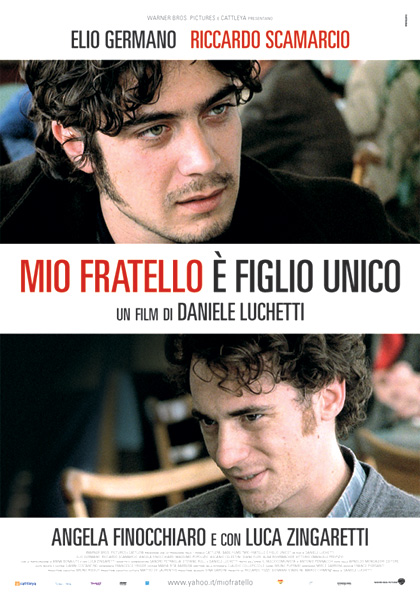
My brother is an only child confirms what I have been suspecting for a long time: at a time of socio-economic downfall, nations rediscover culture as a means to address those woes and frustrations that are seemingly unsolvable in the political sphere. In fact, this movie is far less about the Italian 1960s and 70s than about the current empasse that has locked the country in a seemingly-endless downward spiral.

My brother tells the story of two siblings, Accio (Elio Germano) and Manrico (Riccardo Scamarcio), who find in the two opposing ideologies that have dominated the Italian political scene for most of the last century - Communism and Fascism - an answer to what they consider the injustices that the working classes have to bear in post-war Italy. This political fracture will bring them into personal conflict, as they both become increasingly radicalised in their respective parties.
What sets this film apart from other similar portraits of Italian political/familiar strife is the complexity and humour of Accio's character, who unlike other stylised figures of Italian cinema distances himself from sterile politicisations, rejects compromises and remains throughout the movie an outcast, a rebel and dreamer. His final act is one that challenges a very Italian preconception - that the State, whether Fascist, Communist of Christian Democrat - should be relied on to take care of its citizens. Accio relises that the only way for himself (Italy) to break free of the quicksands in which he (it) has fallen is to stop relying on external ideologies and interventions, and get things done on his own.

This is an extremely important message that the director sends out to his viewers through carefully-orchestrated humourous twists. One might recall some Italian anarchic theorists (Accio is unquestionably an anarchist at heart), but the film is for the most part anti-political, at least in the most Italian sense of the world, desecrating one after the other the empty ideologies behind which so many mediocre bullies have hidden so far to justify their incompetence and arrogance. This is not a portrait of Italy in the 1970s, where ideologies and loyalty to party dominated the political debate. It's a call for the 2000s, precisely against those who use labels to stall the democratic process in their favour.
Or at least, this is how I read the message of the film: "there is no reason to take sides, because neither side has at heart the good of the people and of the nation; what we need to do is to distance ourselves from these political shenanigans and start acting independently".

Apart from all this political ranting, the film reveals in particular the amazing acting qualities of Vittorio Emanuele Propizio as the younger Accio and Elio Germano as the older Accio. The latter in particular gave a truly remarkable performance, and I am glad to see we have at last talented Italian actors emerging after years of overall mediocrity. A special mention goes to Angela Finocchiaro, whose brief appearances on screen as Accio and Manrico's mother carry an extraordinary theatrical weight.
Don't miss it. The best Italian movie since Romanzo Criminale.


2 comments:
ha. i actually interviewd elio 2 years ago. err about his hopes and dreams about the rome film festival doing anyhing for italian cinema. err.
anyway. i have completely given up on italian cinema so had ignored this. but now will go dig it up. when one is inside the rot it's hard to tell the wood from the trees. that is why i rely on my tots.
Am going to see it tonight, with F.
Can't wait!
Post a Comment